

| Concept | Definition | Characteristics | Investment strategies |
|---|---|---|---|
| Bull Market | Period of price increase | Optimism, high demand | Buy and retain, invest in risk assets |
| Bear Market | Period of price decline | Pessimism, high sales pressure | Short sale, sales options, safe haven values |
Introduction to Bull and Bear Markets
Financial markets are often described through the terms bull market and bear market, two fundamental concepts for any investor. A bull market is characterized by a prolonged upward trend in asset prices, often fuelled by investor optimism, a growing economy and strong business profits. Conversely, a bear market is marked by a prolonged decline in prices, usually accompanied by pessimism, economic recession and business losses. Understanding these cycles is crucial to effectively navigate the investment world, particularly in the area of cryptocurrency where volatility is particularly pronounced.
In the context of cryptocurrency, bull and bear markets can be even more extreme. Investors need to be particularly vigilant and informed to take advantage of opportunities while minimizing risks. Why is it important to understand these cycles? Because they directly influence investment strategies and portfolio management. In times of bull market, investors may be tempted to take more risks to maximize their gains, while in bear market, capital preservation often becomes the priority.
In short, understanding bulls and bear markets not only optimizes investment strategies but also better anticipates market movements. This is particularly true for cryptocurrency, where fluctuations can be rapid and significant.
Characteristics of Bull Markets
Bull markets are often characterized by sustained increases in asset prices, increased investor confidence and an expanding economy. What are the signs of a bull market? An increase in stock indices, an increase in business profits and an inflow of capital into markets. In the cryptocurrency world, a bull market can be triggered by technological innovations, increased adoption or favourable regulations.
Characteristics of Bear Markets
In contrast, bear markets are reflected in a prolonged decline in prices, a decline in investor confidence and often an economic recession. How do I recognize a bear market? By decreasing stock indices, declining profits and capital withdrawal. In the cryptocurrency sector, a bear market can be exacerbated by restrictive regulation, cyber attacks or a loss of confidence in the underlying technologies.
| Market type | Characteristics | Impact on Cryptocurrency |
|---|---|---|
| Bull Market | Optimism, Economic growth | Price Increase, Increased Adoption |
| Bear Market | Pessimism, Economic Recession | Lower prices, Withdrawal of capital |

Characteristics of Bull Markets
The bull markets are periods of prolonged increases in the prices of financial assets, often marked by widespread investor optimism. These markets are characterized by a continuous increase in prices, usually by 20% or more, after a previous decline. Bull markets are often fuelled by positive economic factors, such as economic growth, low interest rates, and strong consumer confidence.
What are the signs of a bull market? Typical signs include an increase in the volume of transactions, an increase in stock indices, and an improvement in business profits. Investors are becoming more confident, resulting in increased investment and reduced market volatility.
Investment strategies in bull market Investing in a bull market requires a strategic approach. Investors often seek to buy early to take advantage of rising prices. Growth measures, which benefit from a sharp increase in profits, are particularly popular. In addition, diversifying its portfolio to include expanding sectors can maximize gains. However, it is crucial to remain vigilant and monitor signs of trend reversal to avoid potential losses.
Bull Market indicators
The indicator signs of a bull market include a sustained increase in stock prices, an increase in the volume of transactions, and an improvement in business profits. Investors are becoming more optimistic, resulting in increased investment and reduced market volatility. Stock indices, such as the S&P 500, often show significant gains, increasing investor confidence.
Investment strategies in Bull Market
Investing in a bull market requires a strategic approach. Investors often seek to buy early to take advantage of rising prices. Growth measures, which benefit from a sharp increase in profits, are particularly popular. In addition, diversifying its portfolio to include expanding sectors can maximize gains. However, it is crucial to remain vigilant and monitor signs of trend reversal to avoid potential losses.
| Year | Growth (%) |
|---|---|
| 2020 | 15 |
| 2021 | 25 |
| 2022 | 10 |
| 2023 | 30 |
Characteristics of Bear Markets
Bear markets, or downside markets, are characterized by a prolonged fall in asset prices, often accompanied by widespread pessimism among investors. These periods are marked by a decrease in investor confidenceThis leads to a massive sale of assets and a fall in prices. Bear markets can last several months or years and are often triggered by adverse economic factors, such as recessions or financial crises.
One of the key indicators of a bear market is a sustained decline in prices, usually 20% or more compared to recent peaks. This decline is often accompanied by a high volume of transactions, as investors seek to liquidate their positions to avoid greater losses. Bear markets can also be characterized by increased volatility, especially in cryptocurrency, where price fluctuations can be even more pronounced.
To navigate a bear market, prudent investment strategies are crucial. Diversification is a key strategy to minimize risks, since it allows investment to be spread over different assets, thus reducing the impact of the decline in a single asset. Long-term investment is also recommended as it overcomes short-term fluctuations and benefits from potential market recovery.
In the context of cryptocurrency, bear markets can offer buying opportunities for knowledgeable investors. Low prices may represent a chance to acquire assets at reduced values, in anticipation of future recovery. However, it is essential to remain vigilant and to understand market dynamics well in order to avoid potential pitfalls.
Bear Markets indicators
Bear markets are often preceded by indicators such as a prolonged fall in prices and a high volume of transactions. These indicators indicate a loss of investor confidence, which results in a massive sale of assets. Lower markets can also be triggered by adverse economic events, such as a recession or financial crisis. In cryptocurrency, these signs can be even more pronounced because of the volatility inherent in these assets.
Strategies for navigating the Bear Markets
Navigating in a bear market requires prudent investment strategies. Diversification is essential to reduce risks, since it allows investment to be spread over several assets. Long-term investment is also recommended as it helps overcome short-term fluctuations. In the context of cryptocurrency, bear markets can offer buying opportunities at reduced prices, but it is crucial to stay informed and understand market dynamics to avoid potential pitfalls.
| Year | Percentage decrease |
|---|---|
| 2020 | -20% |
| 2021 | -15% |
| 2022 | -30% |
| 2023 | -10% |

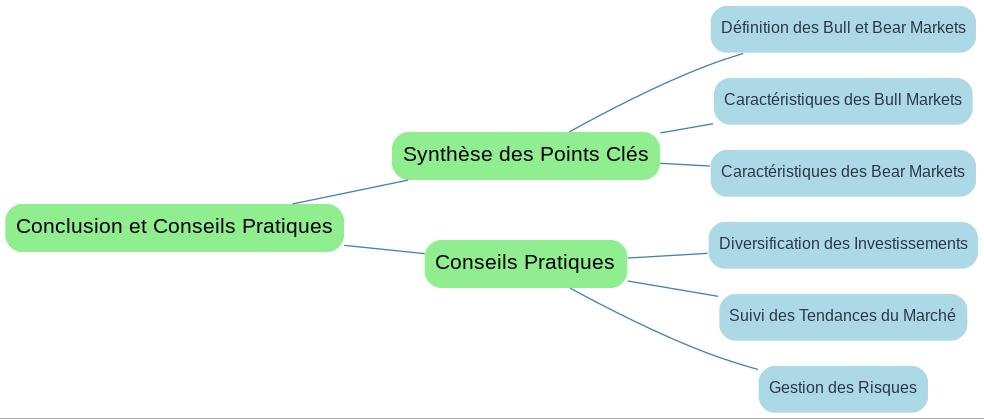
Conclusion and Practical Advice
In this article, we explored the fundamental concepts of bull and bear markets, highlighting their distinctive characteristics and their impact on investments, particularly in cryptocurrency. Understanding these market cycles is essential for any investor wishing to maximize their gains and minimize their risks.
Bull markets, characterized by general price increases and growing optimism, offer lucrative investment opportunities. On the other hand, bear markets, marked by lower prices and pessimism, require a more cautious and strategic approach. The key to success is the ability to adapt its investment strategies to market conditions.
In order to navigate effectively in these changing environments, diversification of investments, careful monitoring of market trends and proactive risk management are crucial. By adopting a disciplined and informed approach, investors can not only protect their capital, but also take advantage of the opportunities offered by market fluctuations.
Summary of Key Points
Bull markets are characterized by sustained price increases, often fuelled by widespread optimism and strong investor demand. Conversely, bear markets are defined by a prolonged decline in prices, accompanied by a feeling of pessimism and massive sales. It is crucial to recognize these cycles to adjust its investment strategies accordingly.
Practical Tips for Investors
To succeed in a volatile market environment, diversification of investments is essential to reduce risk. Monitoring market trends and keeping informed of economic developments can help anticipate market movements. Finally, rigorous risk management, including the use of stop-loss and regular re-evaluation of its portfolio, is essential to protect its capital.
FAQ
What is a bull market?
What is a bull market?
A bull market is a period when the prices of financial assets, such as shares or cryptocurrency, increase steadily. This generally reflects increased investor confidence and a growing economy.
How do I recognize a bear market?
How do I recognize a bear market?
A bear market is characterized by a prolonged decline in asset prices, often by 20% or more compared to recent peaks. The signs include a decline in investor confidence, massive sales and a slowing economy.
Why is this called a bull market?
Why is this called a bull market?
The term ‘bull market’ comes from the way a bull attacks, pushing its horns upwards, symbolizing the rise in prices.
Why do we say bear market?
Why do we say bear market?
The term ‘bear market’ is used because a bear attacks by sweeping its legs down, symbolizing the fall in prices.
What is a bear market in crypto?
What is a bear market in crypto?
A bear market in crypto is a period when cryptocurrency prices fall significantly and for a long time, often accompanied by a decline in investor interest.
How to Trade in Bear Market?
How to Trade in Bear Market?
To trade in bear market, it is advisable to focus on protective strategies such as short selling, buying sales options, or investing in safe haven assets.
What is the definition of a bear market in French?
What is the definition of a bear market in French?
In French, a bear market is defined as a cash market, characterized by a prolonged fall in the prices of financial assets.